

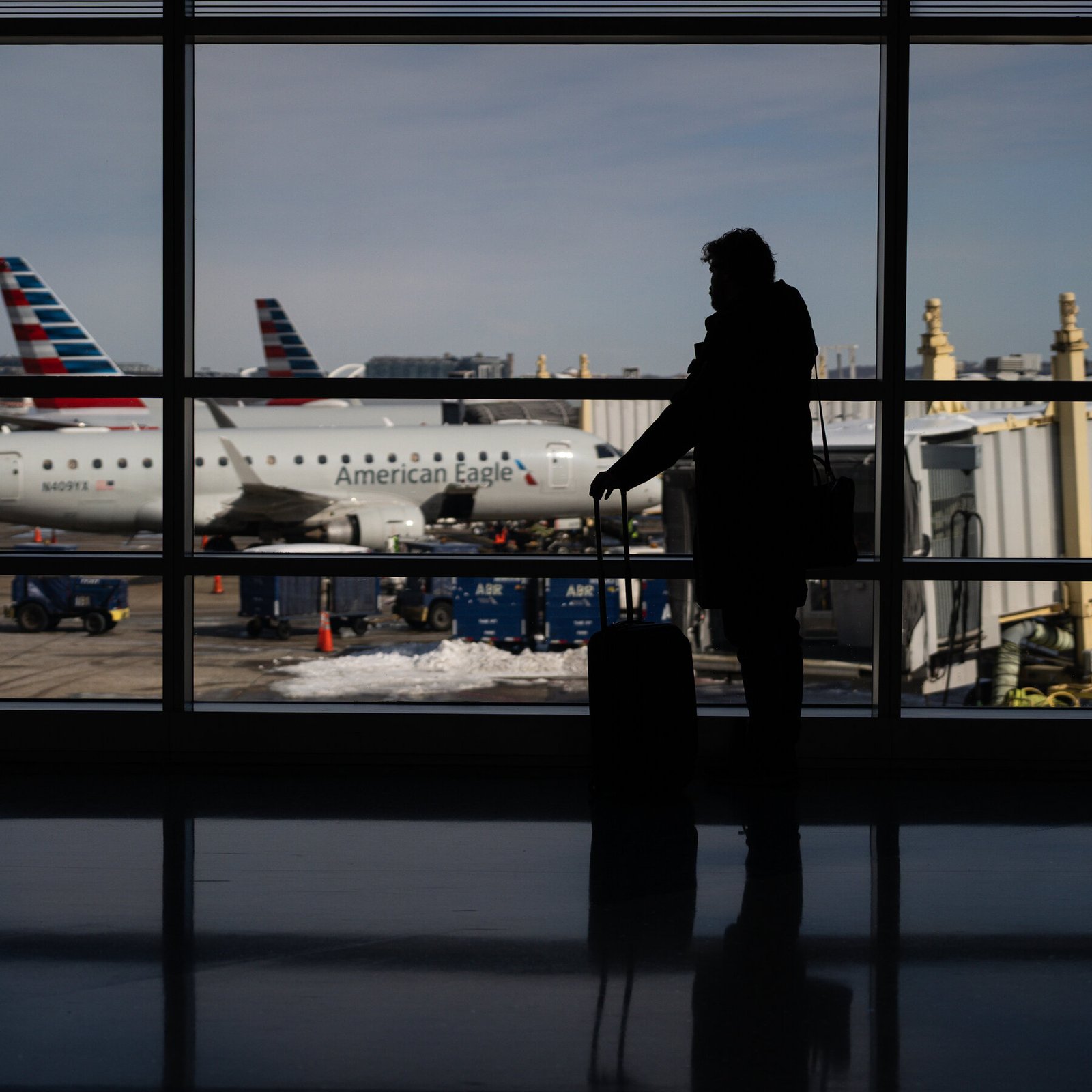
a region that sits at the heart of global long-haul aviation routes.
By midday trading, shares in International Airlines Group (IAG), the parent company of British Airways, Iberiaand Aer Lingus had fallen more than 5% in London. In Paris, Air France-KLM dropped nearly 9%, while Frankfurt-listed Lufthansa slid around 6%.
The sell-off extended beyond Europe. In Asia-Pacific markets, Qantas, Cathay Pacific, Singapore Airlines and Japan Airlines each lost roughly 5% as trading opened for the week.
Across the Atlantic, U.S. carriers were also bracing for heavy losses. In premarket trading, American Airlines, Delta Air Lines and United Airlines were down more than 5%, despite their comparatively smaller direct exposure to Middle Eastern routes.
Notably, the region’s aviation heavyweights, Emirates, Etihad Airways and Qatar Airways are government-owned and privately held, shielding them from immediate stock market volatility. But their operational disruption is central to the global market reaction.
Airspace Shutdowns Trigger Global Shockwaves
The market turmoil follows a weekend of intense military escalation between Israel, the United States and Iran, which triggered widespread airspace closures across the Middle East.
Airspace over Iran, Iraq, Kuwait, Bahrain, Qatar, Israel and the United Arab Emirates was either fully or partially closed at various points, effectively sealing off one of the busiest corridors in global aviation.
The Middle East acts as a bridge between Europe, Asia and Africa. Major hubs such as Doha, Dubai and Abu Dhabi serve as critical connecting points for long-haul passengers travelling between continents. When these hubs halt operations, the ripple effects are immediate and far-reaching.
Tens of thousands of flights were delayed or cancelled over the weekend, with aircraft grounded, diverted or rerouted through longer paths over Saudi Arabia, Egypt or Central Asia. Airlines scrambled to reposition crews and aircraft, manage passenger backlogs and absorb the sudden spike in fuel costs from extended flight times.
Structural Exposure of European Carriers
European airlines are particularly exposed. Routes to Asia, especially India, Southeast Asia, China and Australia — often depend on airspace over the Middle East. Forced diversions can add several hours to flight times, pushing up fuel burn and crew costs while reducing aircraft utilisation.
For groups like IAG and Lufthansa, which have spent the past two years rebuilding margins after the pandemic-era collapse in travel demand, the disruption threatens to reverse hard-won gains. Rising oil prices compound the pressure; jet fuel typically represents one of the largest cost components for airlines, and geopolitical conflict in the region historically triggers crude price spikes.
Even airlines with limited direct Middle Eastern operations cannot escape the knock-on effects. Aircraft scheduling is globally interconnected. A delayed inbound flight in Doha can disrupt onward services to London, New York or Singapore. With summer travel season approaching in Europe and North America, capacity constraints could quickly intensify.
Hub-and-Spoke Vulnerabilities
The business models of Emirates, Etihad and Qatar Airways rely heavily on hub-and-spoke connectivity. Doha, Dubai and Abu Dhabi are not simply origin-destination airports, they are global transit engines.
When those hubs close, millions of passengers en route between continents are stranded mid-journey. Unlike point-to-point carriers, hub-based airlines face a cascade effect: one cancelled bank of arrivals disrupts an entire wave of departures.
Investor Anxiety and Historical Parallels
Aviation markets have long reacted sharply to geopolitical shocks. From the Gulf Wars to post-9/11 airspace restrictions and the Russia-Ukraine conflict which forced Western carriers to avoid Russian airspace — investors have learned that route closures can reshape profitability overnight.
The war in Ukraine, for instance, permanently altered flight paths between Europe and Northeast Asia, raising costs for carriers barred from Russian airspace. A sustained Middle East shutdown could create similar structural adjustments.
Analysts warn that even if hostilities ease quickly, the perception of risk alone may weigh on bookings, particularly for connecting travel through the region. Insurance premiums for airlines operating near conflict zones may also rise.
What Comes Next
By Monday afternoon, some limited flight operations had resumed in parts of the region, but airlines cautioned that schedules would remain fluid. Operational normalisation could take days or weeks, depending on the trajectory of military activity.
For now, markets are pricing in uncertainty. Airline shares, which had rallied strongly over the past year on the back of resilient travel demand and strong pricing power, are once again exposed to forces beyond their control.
